.png)



Why Pipeline Reports Fail Finance Review
- Jan 21
- 5 min read
Updated: Mar 12
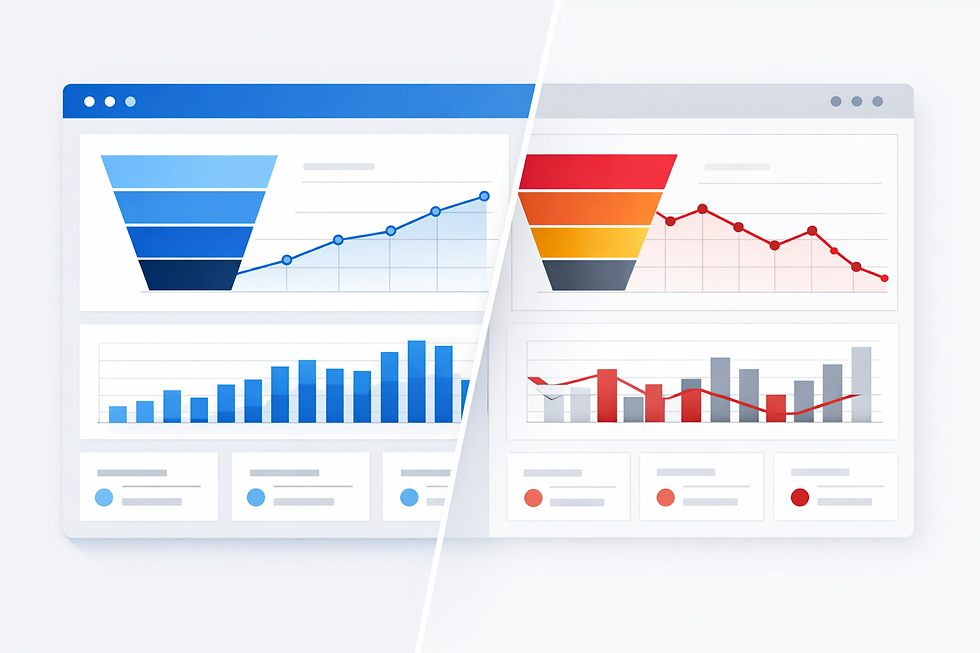
When Pipeline Numbers Don’t Match, Trust Breaks First
Pipeline reports are supposed to create confidence. Instead, they often do the opposite.
In executive meetings, pipeline numbers are one of the fastest ways to expose misalignment between Finance and Marketing. Marketing reports healthy pipeline growth. Sales echoes momentum. Finance pauses, asks a few clarifying questions—and confidence evaporates.
Not because Finance is adversarial. But because pipeline reporting accuracy rarely meets Finance’s standard of review.
Historical client data shows this pattern repeatedly: pipeline reports fail not due to poor performance, but due to weak methodology. Definitions shift. Timing differs. Attribution is unclear. And when Finance cannot reconcile pipeline to revenue reality, credibility breaks long before forecasts do.
Organizations often struggle because their marketing reporting infrastructure is not designed for financial analysis.
Why Finance Reviews Pipeline Differently Than Marketing
To understand why pipeline reports fail Finance review, it’s critical to understand how Finance interprets pipeline.
Marketing often views pipeline as a directional signal—an indicator of future opportunity. Finance views pipeline as a risk-weighted forecast input that informs:
Revenue projections
Cash flow planning
Hiring decisions
Budget allocation
These are not theoretical exercises. They are commitments with downstream consequences.
Finance therefore asks different questions:
What qualifies as pipeline versus activity?
How reliable is each stage?
What assumptions are embedded in conversion rates?
How has this historically reconciled to booked revenue?
Most pipeline reports aren’t built to answer those questions.
Failure Point #1: Inconsistent Pipeline Definitions
Pipeline reporting accuracy collapses the moment definitions drift.
Marketing may define pipeline as marketing-qualified opportunities. Sales may define it as sales-accepted deals. Finance often defines pipeline as late-stage opportunities with historical conversion validity.
When these definitions coexist in a single report—often unintentionally—the numbers lose meaning.
From Finance’s perspective, inconsistent definitions introduce forecasting risk. If the organization cannot agree on what “pipeline” represents, Finance cannot responsibly rely on it for planning.
Historical client data shows this is the most common reason Finance discounts pipeline reports entirely.
Failure Point #2: Stage Inflation and Optimism Bias
Pipeline stages are rarely neutral.
Marketing and Sales teams are incentivized to show growth and momentum. Pipeline stages reflect optimism as much as probability. Early-stage deals are counted with the same visual weight as late-stage opportunities.
Finance doesn’t assume intent equals likelihood.
Finance asks:
How often does Stage 2 convert to Stage 4?
How long do deals stall at each stage?
What percentage of pipeline historically evaporates?
Most pipeline reports present totals without probability adjustment, stage decay analysis, or historical reconciliation.
From a Finance perspective, this is not forecasting—it’s aggregation.
Failure Point #3: Pipeline Isn’t Aligned to Revenue Recognition
Pipeline reporting accuracy breaks down when pipeline logic ignores revenue recognition reality.
Finance operates under strict rules around when revenue can be recognized, forecasted, and disclosed. Pipeline reports often exist entirely outside that framework.
Common disconnects include:
Counting pipeline that cannot close within the reporting period
Including opportunities that lack budget approval
Ignoring contractual or operational constraints
When pipeline is disconnected from revenue recognition standards, Finance cannot map opportunity to outcome.
Historical client data shows Finance often flags these reports as directional at best—and excludes them from formal forecasts entirely.
Failure Point #4: Attribution Obscures Pipeline Integrity
Attribution issues don’t stop at marketing performance—they extend directly into pipeline credibility.
When pipeline is attributed to campaigns, channels, or initiatives without clear methodology, Finance questions whether the pipeline exists independently of reporting assumptions.
Finance wants to know:
Would this opportunity exist without this campaign?
How are overlapping influences handled?
Are we double-counting influence as creation?
Pipeline reports that rely on opaque or platform-native attribution models struggle to survive Finance review.
Pipeline reporting accuracy requires attribution transparency—not just attribution labels.
Failure Point #5: No Historical Reconciliation to Reality
Finance rarely trusts forecasts without historical grounding.
Yet many pipeline reports exist in isolation—showing current volume without reconciling to past performance.
Critical missing context often includes:
Historical close rates by stage
Forecast versus actual variance
Pipeline aging and decay patterns
Without this, Finance cannot assess reliability.
Historical client data shows Finance teams consistently ask one question pipeline reports fail to answer:
Without that answer, pipeline becomes narrative—not input.
Failure Point #6: Timing Mismatches Destroy Forecast Confidence
Pipeline timing is rarely as clean as reporting suggests.
Marketing reports pipeline creation by month. Sales updates stages weekly. Finance forecasts quarterly. These timelines collide inside pipeline reports.
The result:
Opportunities counted multiple times across periods
Pipeline that appears to grow without converting
Forecasts that shift without explanation
From Finance’s perspective, timing mismatches introduce planning risk.
Pipeline reporting accuracy requires temporal alignment—not just totals.
What Finance-Ready Pipeline Reporting Looks Like
Pipeline reports that survive Finance review share common traits.
1. Unified Definitions Across Teams
Pipeline stages, qualification criteria, and inclusion rules are documented and enforced. Marketing, Sales, and Finance review the same definitions.
2. Probability-Weighted Forecasting
Pipeline is adjusted based on historical conversion rates, stage decay, and cycle length. Optimism is replaced with evidence.
3. Revenue Recognition Alignment
Pipeline logic respects contractual, operational, and timing constraints. Finance can map pipeline to forecast without reinterpretation.
4. Transparent Attribution Methodology
Attribution is documented, consistent, and conservative. Influence is not mistaken for creation.
5. Historical Accuracy Tracking
Pipeline forecasts are continuously reconciled to actual revenue. Variance is measured, explained, and used to refine models.
Why Most Organizations Struggle to Get This Right
Pipeline reporting sits at the intersection of incentives.
Marketing wants to show growth. Sales wants to show momentum. Finance wants defensibility.
Most organizations lack a neutral framework that satisfies all three.
Historical client data shows attempts to fix pipeline reporting often focus on tools, dashboards, or CRM hygiene—without addressing the underlying governance problem.
Pipeline reporting accuracy isn’t a software problem. It’s a methodology problem.
The Cost of Pipeline Reports Finance Can’t Trust
When pipeline reports fail Finance review, the consequences extend beyond reporting.
Forecasts lose credibility
Budget decisions slow or freeze
Hiring plans are delayed
Marketing impact is discounted
In extreme cases, leadership stops using pipeline entirely—relying on lagging indicators instead.
That shift costs organizations speed, confidence, and strategic clarity.
Final Thought: Accuracy Precedes Optimism
Pipeline is one of the most powerful planning tools an organization has—when it’s trusted.
Pipeline reporting accuracy isn’t about showing the largest possible number. It’s about showing the most defensible one.
When Finance, Marketing, and Sales can review the same pipeline with confidence, pipeline becomes what it was always meant to be:
A shared view of future revenue—not a source of internal doubt.
The problem frequently begins with the underlying marketing data architecture.
Ready to Pressure-Test Your Pipeline Reports?
If Finance questions your pipeline numbers, the issue isn’t visibility—it’s defensibility.
In a 30-minute executive review, we walk through:
Where pipeline definitions typically break Finance trust
How forecasting assumptions create hidden risk
Whether your current pipeline reporting would survive Finance review
This is a working session, not a sales demo.
Schedule a 30-minute executive pipeline review:👉 book now
Bring your current pipeline report. We’ll review it the way Finance does—methodology first, optimism second.


Comments