.png)



Why Pipeline Reports Fail Finance Review
- Jan 21
- 8 min read
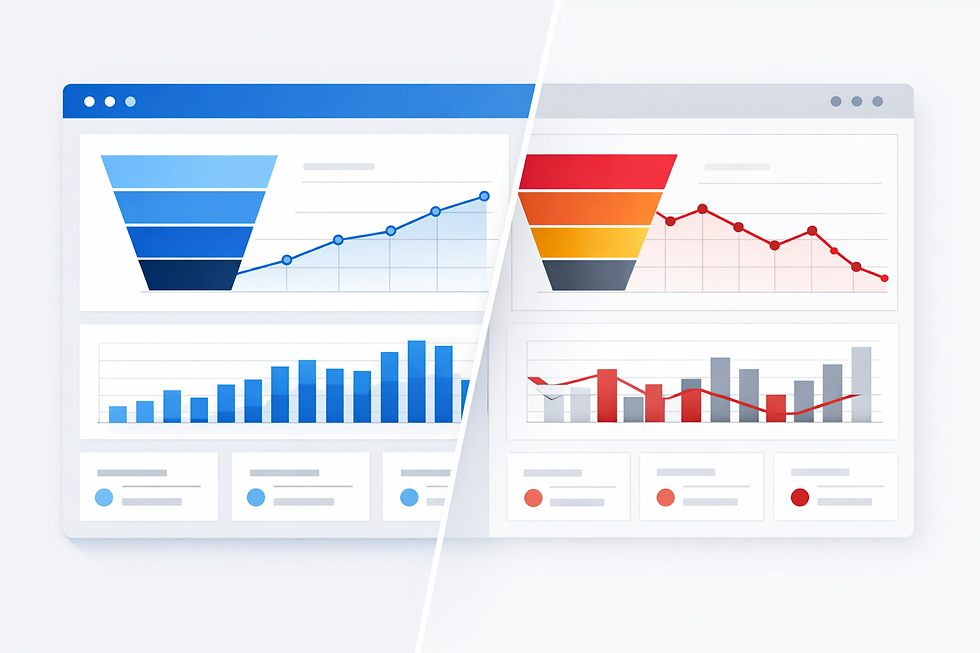
Pipeline reports often fail finance review because they show sales movement without proving revenue confidence.
A pipeline report may show open opportunities, deal stages, forecasted revenue, close dates, sales activity, opportunity owners, and expected value. On the surface, the report may look complete.
But finance often reviews pipeline differently.
The CFO is not only asking whether pipeline exists. Finance wants to know whether the pipeline is reliable, whether the opportunities are qualified, whether the revenue is likely to close, whether margin is healthy, and whether the forecast can support budget and growth decisions.
That is where many pipeline reports break down.
Sales may see activity. Marketing may see influenced opportunities. Finance may see uncertainty. Leadership may see a forecast that looks promising but still feels risky.
The issue is not always the pipeline itself.
The issue is often that the pipeline report does not connect sales activity, marketing source, revenue quality, customer fit, profitability, and forecast confidence into one trusted business view.
That is why Cross-Department Visibility matters. Pipeline reporting only becomes useful at the executive level when marketing, sales, finance, operations, and customer data are connected clearly enough to support decisions.
Why Pipeline Reports Fail Finance Review
Pipeline reports fail finance review when they are built around sales activity instead of financial confidence.
A sales team may use a pipeline report to manage deals.
That usually means tracking:
open opportunities
deal stage
opportunity value
expected close date
sales owner
recent activity
next steps
probability to close
forecast category
These are useful sales management metrics.
But finance reviews pipeline through a different lens.
Finance usually wants to know:
how reliable the forecast is
which opportunities are truly qualified
whether deal values are realistic
whether close dates are credible
whether pipeline is inflated
whether revenue quality is strong
whether margin is visible
whether customer fit supports profitability
whether leadership can trust the forecast
A pipeline report can help sales manage activity and still fail finance review.
That happens when the report does not answer the financial questions behind the forecast.
The First Problem: Pipeline Volume Is Mistaken for Revenue Confidence
Pipeline volume can look reassuring.
A report may show that the company has $5 million, $10 million, or $20 million in pipeline.
But pipeline volume does not automatically create revenue confidence.
Finance needs to know whether that pipeline is realistic.
A large pipeline may still be weak if:
opportunities are poorly qualified
deal stages are outdated
close dates are optimistic
sales probabilities are inconsistent
customer fit is unclear
deal values are inflated
the sales cycle is lengthening
the pipeline depends on low-quality leads
opportunities lack clear next steps
This is why finance may question pipeline reports even when the top-line number looks strong.
The issue is not the size of the pipeline.
The issue is the quality of the pipeline.
The Second Problem: Sales Stages Are Not Financial Proof
Sales stages help sales teams manage deals.
But finance cannot always treat sales stages as financial proof.
An opportunity marked as “proposal sent” or “negotiation” may look advanced, but finance may still need to understand whether the opportunity is actually likely to close.
A sales stage may not answer:
whether the buyer has budget
whether the decision maker is engaged
whether the timeline is realistic
whether there is a clear business need
whether legal or procurement may delay the deal
whether the deal has margin risk
whether the customer is a strong fit
whether the forecasted close date is credible
If sales stages are updated inconsistently, the pipeline report becomes even less reliable.
Finance needs pipeline data that reflects real forecast confidence, not just movement through CRM stages.
The Third Problem: Forecast Probability Is Often Too Subjective
Many pipeline reports rely on probability percentages.
For example:
25 percent probability
50 percent probability
75 percent probability
90 percent probability
These numbers can look precise.
But if probability is based mostly on sales judgment or default CRM stage percentages, finance may question whether the forecast is reliable.
A probability model should be based on real deal evidence.
That may include:
buyer engagement
decision-maker involvement
budget confirmation
sales cycle stage
historical conversion rates
deal type
customer segment
source quality
previous win rates
close-date accuracy
Without this context, probability can create false confidence.
Finance may see the report and ask whether the forecast is based on evidence or optimism.
That is a valid question.
The Fourth Problem: Pipeline Reports Ignore Revenue Quality
Revenue quality matters as much as revenue volume.
A pipeline report may show potential revenue, but finance may need to understand what kind of revenue it is.
Not all pipeline is equally valuable.
Some opportunities may be high revenue but low margin. Others may require heavy delivery resources. Some may involve customers that are difficult to serve or unlikely to retain.
Finance may want to know:
is the opportunity profitable?
what margin is expected?
how much delivery effort will it require?
is the customer a strong fit?
is the deal likely to renew or expand?
does the customer match the company’s ideal profile?
will the deal create operational strain?
If pipeline reporting does not include revenue quality, finance may not trust the forecast as a decision tool.
This is where Revenue Intelligence becomes important. Leadership needs to understand not only how much revenue may close, but whether that revenue supports healthy business performance.
The Fifth Problem: Marketing Source Is Disconnected From Pipeline Quality
Pipeline reports often fail finance review because they do not connect marketing source to pipeline quality.
Marketing may report that a campaign influenced pipeline.
Sales may report that the pipeline exists.
Finance may ask whether the pipeline is likely to close and create profitable revenue.
If those views are disconnected, leadership cannot easily understand whether marketing is creating the right kind of demand.
A pipeline report should help answer:
which sources create qualified opportunities
which campaigns produce stronger close rates
which channels create lower-quality pipeline
which sources create high-margin customers
which leads require too much sales effort
which marketing investments deserve more budget
Without that connection, marketing and sales may both report positive activity while finance still questions the business value.
This is also why why channel metrics without financial context mislead leadership. Channel performance only becomes useful when it connects to pipeline quality, revenue quality, and profitability.
The Sixth Problem: CRM Data Cannot Support the Forecast
Pipeline reports depend on CRM data.
If CRM data is incomplete or inconsistent, finance may question the entire forecast.
Common CRM problems include:
outdated deal stages
missing close dates
inflated opportunity values
incomplete lead source fields
unclear next steps
missing buyer information
inconsistent probability logic
duplicate records
poor sales activity documentation
weak connection between marketing source and opportunity quality
When CRM data is unreliable, pipeline reporting becomes unreliable.
Finance does not only review the pipeline number.
Finance reviews whether the pipeline number can be trusted.
If the CRM cannot support the report, the forecast may fail finance review.
The Seventh Problem: Pipeline Reports Do Not Explain What Leadership Should Do Next
A pipeline report may show where opportunities stand.
But executive leadership needs to understand what should happen next.
The report should help answer:
should leadership increase marketing spend?
should sales focus on a specific segment?
should weak pipeline sources be reviewed?
should forecast assumptions be adjusted?
should hiring or capacity plans change?
should operations prepare for demand?
should finance revise projections?
should leadership investigate low-quality pipeline?
If the pipeline report does not support decisions, it remains a sales activity report.
Finance review requires more.
Finance needs a pipeline report that supports planning, forecasting, budget decisions, and risk management.
Why Finance Reviews Pipeline Differently Than Sales
Sales teams often use pipeline reports to manage momentum.
Finance uses pipeline reports to evaluate forecast reliability.
That difference matters.
Sales may ask:
what deals are active?
what is moving forward?
who owns the opportunity?
what is the next step?
what might close this month?
Finance may ask:
what revenue can we reasonably expect?
what is the risk-adjusted value?
how reliable are close dates?
how often does this stage convert?
how does pipeline quality affect cash flow?
how does this forecast affect budget planning?
Both perspectives are important.
But if pipeline reporting is built only for sales management, it may not satisfy finance.
For a finance-side view of performance reporting, see The CFO’s Perspective on Marketing Performance Metrics. The same principle applies: finance needs performance metrics to connect to financial confidence.
What a Finance-Ready Pipeline Report Should Include
A finance-ready pipeline report should go beyond sales activity.
It should include several key elements.
1. Clear Pipeline Definitions
The business should define what qualifies as pipeline.
This includes rules for opportunity creation, stage movement, probability, forecast category, and close date expectations.
Without definitions, pipeline becomes subjective.
2. Forecast Confidence
The report should show whether opportunities are likely to close based on evidence, not just sales optimism.
Forecast confidence may include historical conversion rates, stage aging, source quality, engagement level, and close-date reliability.
3. Revenue Quality
Pipeline should be evaluated by quality, not only size.
This includes deal size, margin potential, customer fit, retention likelihood, and operational impact.
4. Source and Attribution Context
Leadership should understand where pipeline came from and whether the source tends to produce strong outcomes.
This connects marketing, sales, and finance into one performance view.
5. CRM Data Quality
The report should show whether CRM records are complete and reliable enough to support forecasting.
If data quality is weak, the report should make that visible.
6. Decision Guidance
The pipeline report should explain what leadership should do next.
That may include where to focus sales effort, which sources to review, which forecasts to adjust, or which risks need attention.
A Practical Example
Imagine a company with a strong-looking pipeline.
The CRM shows $8 million in open opportunities.
Sales is optimistic.
Marketing reports that several campaigns influenced the pipeline.
But finance reviews the report and sees concerns.
Many opportunities have not moved stages in weeks. Close dates have been pushed repeatedly. Several large deals come from low-converting sources. Some opportunities are attached to customers that are likely to require heavy support. CRM source data is incomplete.
The pipeline looks strong at the top line.
But the finance review reveals weak forecast confidence.
In this case, the issue is not that sales is wrong.
The issue is that the pipeline report does not provide enough quality, reliability, and financial context.
Why Pipeline Reporting Needs Executive Visibility
Pipeline reporting becomes more useful when it is connected to executive visibility.
Executives do not only need to know how much pipeline exists.
They need to understand:
what pipeline is reliable
what pipeline is risky
what sources create better opportunities
what revenue is likely to be profitable
what assumptions need review
where departments disagree
what leadership should fix first
That is why Executive Visibility matters. Leadership needs reporting that helps interpret performance, not just display metrics.
When Pipeline Reporting Becomes a Cross-Department Problem
Pipeline reporting is rarely only a sales issue.
It involves multiple departments.
Marketing influences demand quality. Sales qualifies and progresses opportunities. Finance evaluates forecast confidence and revenue quality. Operations prepares for delivery capacity. Customer teams understand retention and fit.
If those teams are not connected through the reporting model, pipeline review becomes incomplete.
This is why pipeline reports often fail finance review.
They show one department’s activity, but finance needs a cross-department performance story.
Warning Signs Your Pipeline Reports May Fail Finance Review
Your pipeline reports may fail finance review if:
pipeline volume looks strong but forecast confidence is weak
finance questions close dates or probability
CRM stages are updated inconsistently
marketing source is not connected to pipeline quality
opportunity values are inflated or unclear
pipeline reports do not show margin or customer fit
sales and finance disagree on forecast assumptions
leadership cannot tell which pipeline deserves focus
reports show activity but not decision guidance
budget decisions still feel subjective
These signs indicate that the pipeline report may not be strong enough for executive planning.
When the Problem Is Bigger Than Pipeline Reporting
Sometimes the pipeline report itself needs improvement.
But often, the deeper issue is the visibility system behind it.
If marketing data, CRM data, sales activity, finance definitions, attribution logic, and revenue quality are disconnected, pipeline reports will always have limitations.
A Revenue Clarity Assessment can help identify where pipeline reporting, forecast confidence, CRM data, cross-department visibility, and executive decision support are breaking down.
Final Thought: Pipeline Reports Need More Than Sales Activity
Pipeline reports fail finance review when they show sales movement without enough financial confidence.
Finance does not need a bigger pipeline number.
Finance needs a more trustworthy pipeline story.
That means connecting opportunity data to forecast reliability, revenue quality, customer fit, profitability, and executive decision-making.
When pipeline reporting becomes cross-departmental, leadership can make better decisions about budget, growth, staffing, and risk.
The next step is not adding another pipeline dashboard. It is understanding whether your pipeline reports give leadership the clarity needed to make confident revenue decisions.
Schedule a 30-minute executive pipeline review:👉 book now
Comments